
Water Stewardship for Namibia’s Mining Growth
Namibia’s mining industry continues to attract investment across uranium, gold, copper and other critical minerals, positioning the sector for another period of growth. As mining operations expand, however, success will increasingly be measured not only by production output, but also by how effectively natural resources are managed.
As one of the driest countries in sub-Saharan Africa, Namibia has long recognised that sustainable mining depends on responsible water stewardship. Every stage of the mining value chain—from drilling and blasting to mineral processing and tailings management—influences how effectively water is used, recovered and recycled.
For mining companies, water management extends beyond environmental responsibility. It directly affects production continuity, operating costs and the ability to meet increasingly ambitious sustainability goals. As a result, mining operations are seeking practical ways to recover and reuse more of the water already circulating within their processes.
Maximising Water Recovery
One of the greatest opportunities to improve water efficiency lies within the mineral processing circuit.
While considerable attention is often placed on water supply infrastructure, significant gains can also be achieved by improving the recovery and reuse of process water already available within the operation.
Effective solid-liquid separation plays a critical role in achieving this, making flocculant technology an important component of modern mineral processing.
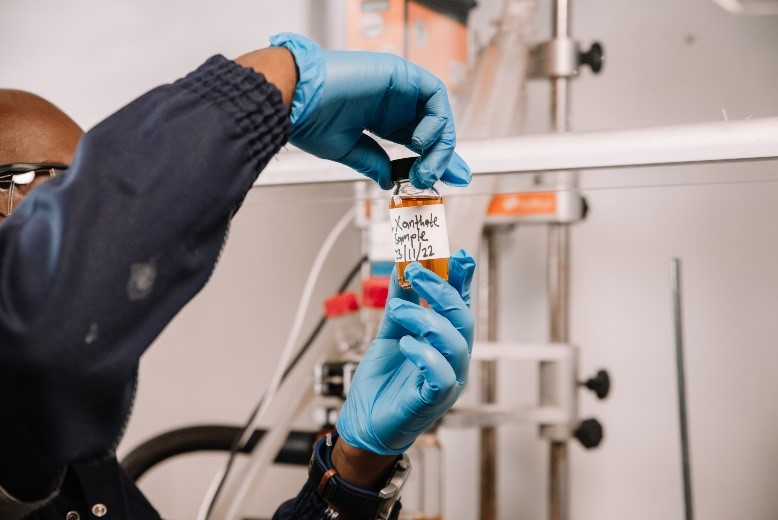
Today’s flocculants are designed to do more than accelerate settling. They can enhance thickener performance, improve water clarity and increase the volume of water recovered and returned to the plant. This can reduce reliance on freshwater resources while contributing to lower operating costs, improved processing efficiency and stronger environmental performance.
These benefits are particularly important in arid mining environments such as Namibia.
AECI Mining works with mining companies to develop flocculant programmes tailored to ore characteristics, processing conditions and production objectives. By improving solid-liquid separation and thickener performance, these solutions can help maximise water recovery and support efficient plant operation in water-constrained environments.
As mining companies continue to pursue operational efficiency while strengthening their ESG performance, technologies that recover more water from every tonne processed will become increasingly important.
Better Mining Through Integration
Water recovery is an important consideration, but it represents only one part of a much larger mining system. Each stage of the process influences the next—from blast fragmentation and downstream crushing efficiency to mineral liberation, metal recovery and ultimately water recovery and recycling.
Mineral processing decisions can affect concentrate quality and tailings behaviour, which in turn influence how effectively water can be recovered and reused.
Considering these functions in isolation can limit opportunities for improvement. An integrated approach enables gains in one area of the value chain to support performance across the wider operation.
This philosophy underpins AECI Mining’s approach to Better Mining.
By combining expertise in explosives, mining chemicals and engineering solutions, AECI Mining works alongside customers to address challenges across the mining value chain. This includes technologies that support improved fragmentation, safer operations and reduced dust, vibration and noise impacts, alongside mining chemicals that enhance metal recovery and water reuse within mineral processing circuits.
Together with engineering capabilities, this integrated approach can help mining operations improve performance while advancing broader sustainability objectives.
A Shared Vision for Namibia’s Mining Future
According to Christel Stergiadis, managing director of AECI Mining Namibia, the country’s mining industry has an opportunity to demonstrate that growth and responsible resource management can go hand in hand.
“Mining has long been a significant contributor to Namibia’s economy, and the industry has consistently shown its ability to innovate and adapt. Water remains one of our most valuable resources, particularly in this part of the world, which is why collaboration between mining companies, technology partners and local stakeholders will continue to be so important in the years ahead.”
She adds:
“As the sector continues to grow, there is an opportunity to adopt practical solutions that strengthen productivity while making better use of the resources on which mining depends.”
Achieving Better Mining requires more than a single product or technology. It depends on partnership, innovation and a shared commitment to developing solutions that create lasting value for the mining industry, the environment and the communities it serves.
About The Author