

Zambia’s $10 Billion Copper Investment Faces Power Constraints
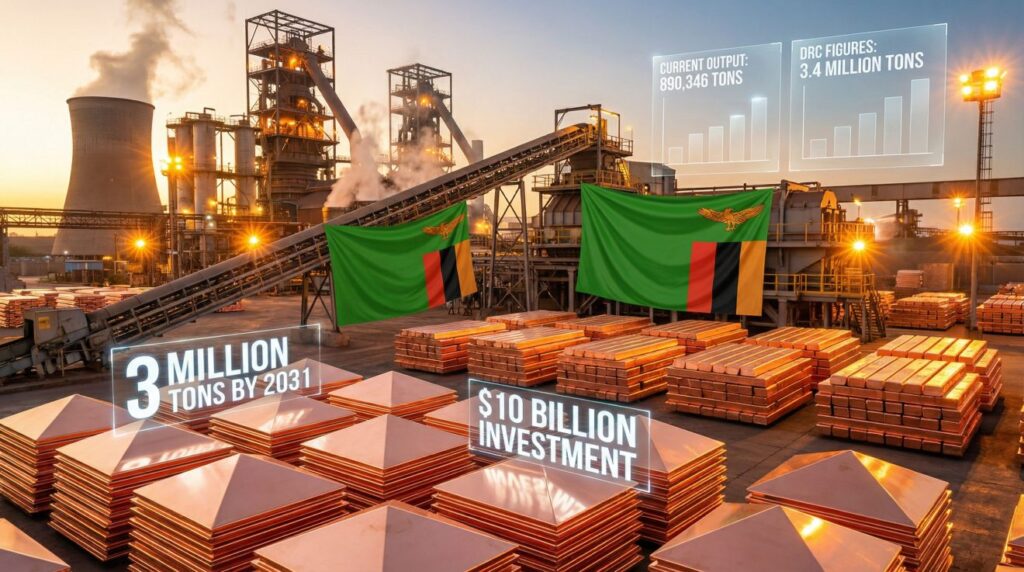
LUSAKA — Zambia has attracted almost $10 billion in mining investment commitments since 2021, but copper production has increased by only about 90,000 metric tonnes over the same period. The gap highlights the challenges the country faces in turning investment pledges into higher production.
The issue is particularly important for President Hakainde Hichilema’s target of tripling Zambia’s annual copper production to 3 million tonnes by 2031 under the National Three Million Metric Tonnes Copper Production Strategy.
Achieving that target would require sustained annual production growth of around 22% from 2025 levels — an ambitious goal given constraints around electricity supply, regulatory processes and the long lead times involved in developing major mining projects.
Copper output remains below target
Zambia produced 890,346 tonnes of copper in 2025, an 8% increase from 825,500 tonnes in 2024 and 732,580 tonnes in 2023.
Despite the growth, production remained below the government’s 1-million-tonne target for 2025.
The nearly $10 billion investment figure also represents announced and committed investment rather than capital that has already been fully deployed. As a result, several major projects have yet to contribute significantly to national production.
Major expansion initiatives include Barrick’s Lumwana super-pit, Vedanta’s investment in Konkola Copper Mines and KoBold Metals’ Mingomba copper project.
These developments could significantly increase Zambia’s future copper output, but bringing large-scale mining projects into production takes years of construction, infrastructure development and commissioning.
Power remains the biggest constraint
One of the most immediate challenges is electricity supply.
Mining consumes roughly half of Zambia’s electricity, and industry executives estimate that the sector could require an additional 2,000MW of generation capacity to support the 3-million-tonne copper target.
The country is working to expand its power-generation base. During the first half of 2026, the Energy Regulation Board backed 16 utility-scale energy projects with combined capacity of more than 1.1GW.
However, these projects still need to be developed, connected and brought into operation before they can provide meaningful additional power to mines.
For Zambia’s copper industry, the availability of reliable and competitively priced electricity will therefore be critical to converting new investment into actual production growth.
Copper demand strengthens the case for investment
The push to increase production comes as global copper markets remain strong.
Copper was trading at close to $14,000 per tonne in early August, while growing demand linked to electricity networks, renewable energy, electric vehicles and broader electrification is expected to place continued pressure on global supplies.
For Zambia, the stakes are particularly high because copper remains central to the national economy. The metal accounted for approximately 70% of total export receipts and 22% of net tax revenues in 2025.
The country therefore has a strong economic incentive to expand production and capture greater value from its copper resources.
Turning investment into production
Zambia’s challenge is no longer simply attracting mining capital. The bigger task is ensuring that committed investment translates into new mines, expanded operations and sustained increases in production.
Improving electricity supply, speeding up infrastructure development and ensuring predictable regulatory processes will be essential if Zambia is to achieve its ambitious 2031 copper target.
With billions of dollars in planned mining investment already on the table, the country’s next phase will depend on how effectively it can turn capital commitments into operating capacity and, ultimately, higher copper output.
About The Author