
DRC Solar-Battery Project Delivers Renewable Power to Mine
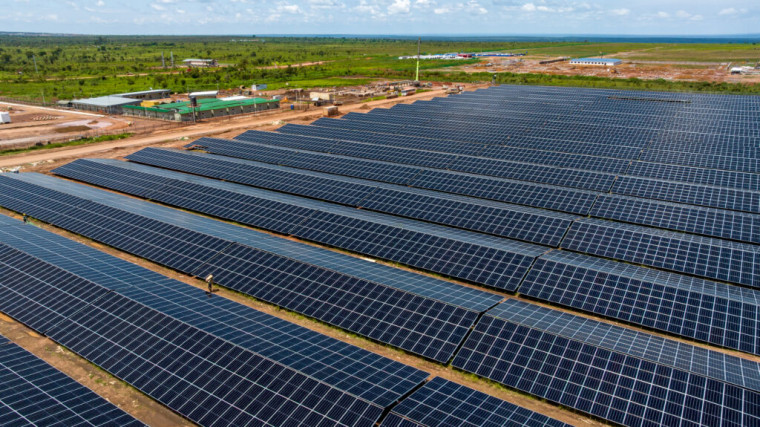
A 233 MWp solar photovoltaic and battery-storage facility has begun commercial operations at the Kamoa-Kakula copper complex in the Democratic Republic of Congo (DRC), providing 30 MW of firm renewable power to one of Africa’s major mining operations.
The project combines large-scale solar generation with 526 MWh of battery energy storage, allowing renewable electricity to be supplied more consistently rather than only when sunlight is available.
Commercial operations began on 12 August following a power purchase agreement signed in April 2025. The development represents a significant step in the use of private renewable-energy infrastructure to support energy-intensive mining while reducing reliance on fuel-based generation.
Solar and storage provide firm power
Unlike conventional solar projects that generate electricity primarily during daylight hours, the Kamoa-Kakula system is designed to provide firm or baseload renewable electricity.
The facility consists of 233 MWp of solar PV and a 123 MVA, 526 MWh battery-energy-storage system.
During periods of solar production, electricity can be stored in the battery system and released when required. This allows the mine to make greater use of renewable electricity throughout the day and into periods when solar generation is unavailable.
For mining operations, this ability to provide power more consistently is particularly important. Stable electricity is essential for mining, mineral processing and supporting infrastructure, while unreliable supply can increase operating costs and the need for backup generation.
Reducing reliance on fuel generation
Kamoa-Kakula has historically relied on a combination of grid electricity, third-party power purchases and on-site generation.
Approximately 193 MW of generator capacity was installed at the complex at the end of 2025, while electricity was also sourced through third-party providers and the Zambia-DRC interconnector.
The solar-and-storage project is intended to address both energy reliability and emissions. By supplying firm renewable electricity, it can reduce the mine’s dependence on fuel-powered generators while providing a more diversified energy supply.
Renewable power and critical minerals
The development has significance beyond the mine itself.
Copper is a critical material for the global energy transition and is widely used in electricity networks, renewable-energy systems, electric vehicles and other electrification technologies.
The DRC is therefore positioned at the intersection of Africa’s mineral economy and the global shift towards lower-carbon infrastructure.
This creates an important challenge for African mining countries. As demand grows for copper, cobalt, lithium, manganese and other transition minerals, producers face increasing pressure to expand output while managing environmental impacts and reducing the carbon intensity of mineral production.
The energy used to extract and process these resources is becoming an increasingly important part of that equation.
Private investment model
The project also demonstrates an alternative approach to financing renewable energy for large industrial consumers.
Rather than requiring Kamoa Copper to finance and own the generation infrastructure itself, the renewable-energy assets are developed, financed and operated by the energy provider, with Kamoa Copper acting as the sole offtaker under the power purchase agreement.
This model can allow mining companies to secure dedicated renewable capacity without taking on the full upfront capital requirements associated with developing and operating a power plant.
Development finance has also helped address the risks associated with major infrastructure projects in African markets.
A proposed guarantee of up to US$237 million from the Multilateral Investment Guarantee Agency is intended to cover certain investment risks, including transfer restrictions and currency inconvertibility, expropriation, and war and civil disturbance.
Such risk-mitigation mechanisms can be important for renewable-energy projects where equipment, financing and other costs may be linked to foreign currencies while revenues are generated locally.
Battery storage gains importance
The project also highlights the growing role of battery storage in Africa’s energy sector.
Solar generation depends on daylight and weather conditions, while industrial facilities often require electricity around the clock. Battery systems can bridge this gap by storing electricity during periods of high solar generation and releasing it when demand continues after solar production declines.
This approach could be particularly relevant to African mining operations located far from reliable national grids or in electricity markets where generation and transmission capacity remain constrained.
Dedicated solar-and-storage systems can provide an additional option alongside grid expansion, conventional generation and diesel-based backup power.
Expansion already underway
The Kamoa-Kakula renewable-energy programme is also being expanded.
The mine’s two solar facilities are expected to reach a combined 433 MW of peak solar capacity and 1,107 MWh of battery storage, providing approximately 60 MW of continuous baseload power once fully ramped up.
Further projects are also being planned, with the aim of increasing on-site solar baseload capacity to around 120 MW by the end of 2027.
The expansion raises a broader question for the DRC: how private industrial energy projects can contribute to wider improvements in electricity infrastructure and local economic development.
While the renewable facilities are dedicated primarily to the mine, the investment demonstrates the potential for private-sector power infrastructure to support industrial activity in a country where electricity access and reliability remain uneven.
A regional energy connection
Kamoa-Kakula is also connected to the wider Copperbelt power system spanning the DRC and Zambia.
The mine has sourced electricity through the Zambia-DRC interconnector, linking its operations to a broader regional electricity network.
This regional connection is significant because the future growth of African mining will depend not only on mineral resources but also on access to reliable and competitively priced electricity.
A model for sustainable mining?
The Kamoa-Kakula project does not eliminate the wider environmental and social challenges associated with mining. Land use, water consumption, worker safety, community relations, tailings management and biodiversity remain important considerations.
However, the project demonstrates how energy procurement is becoming an increasingly important part of mining companies’ operational and sustainability strategies.
For mining operators, renewable energy can offer more than emissions reductions. It can potentially improve control over electricity supply, reduce exposure to fuel costs and provide a more diversified energy portfolio.
The longer-term commercial case will depend on factors including electricity prices, battery replacement costs, equipment performance, grid availability, financing terms and mine production requirements.
The Kamoa-Kakula development nevertheless provides an important example of how solar generation, battery storage and private infrastructure finance can be combined to support Africa’s critical-minerals industry.
For the DRC and other mineral-producing economies, the challenge will be to ensure that renewable-energy investment supports not only lower-carbon mining, but also local skills, supply chains, infrastructure development and greater economic value from the continent’s mineral resources.
About The Author